 NERVOSAVE
Long-lasting pain relief for companion animals.
An investigational local gene therapy approach for dogs living with severe or refractory neuropathic pain.
Chronic nerve pain deserves better options.
Neuropathic pain can be difficult to identify and manage in dogs. Some patients continue to experience pain despite conventional medications or interventions.
Approximate combined dog population used for market planning across the US, Europe, China and Brazil.
A neuropathic pain component has been reported in a veterinary hospital population. This is not an estimate for all dogs.
An internal scenario assumption for the potential priority population, not an established epidemiological rate.
Population and market figures are preliminary planning estimates. The selected hospital finding should not be extrapolated directly to the general canine population.
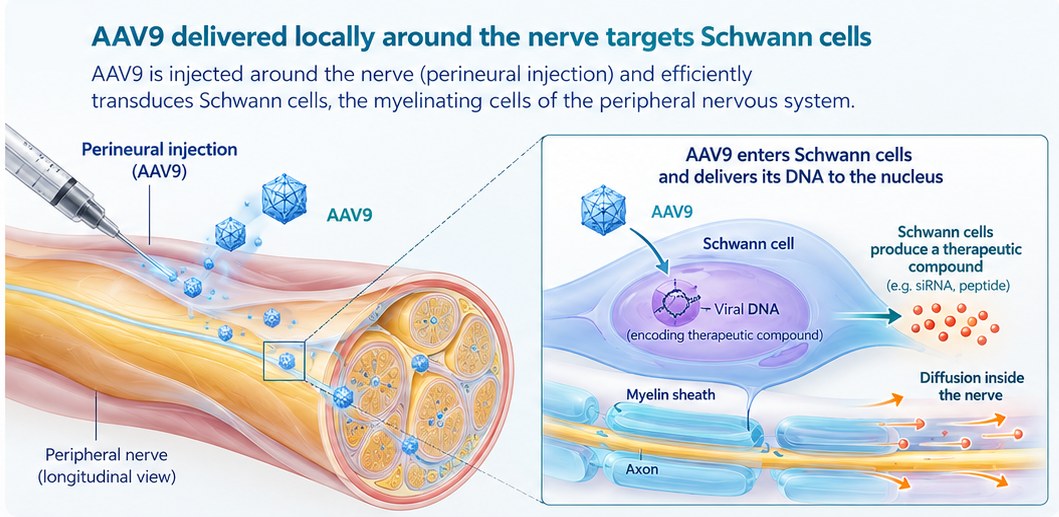
A local approach to nerve pain.
NVO-801V is being developed to deliver an AAV9 vector around a selected peripheral nerve. The goal is to support local expression of an analgesic peptide derived from μ-EPTX-Na1a, with a mechanism involving the Nav1.8 sodium channel.
The intended effect is to reduce pathological pain signalling while preserving motor function, ordinary sensation and protective acute pain. These properties remain to be demonstrated in dogs.
Where we aim to make a difference.
Lumbosacral stenosis and sciatic pain
Intervertebral disc disease with radicular pain
Post-surgical neuropathic pain
Diabetic neuropathy
Trigeminal neuralgia
From early research to canine proof of concept.
Mechanistic rationale
Analgesic peptide activity and early rodent studies support continued investigation. These results do not establish efficacy in dogs.
Veterinary evaluation
Design and conduct appropriate canine feasibility, safety and efficacy studies with specialist veterinary partners, subject to required approvals.
Regulatory development
Advance evidence generation and regulatory planning for potential future veterinary use in China and other markets.
Build the first canine evidence together.
We are seeking veterinary clinical networks, scientific collaborators and strategic investors to help advance NVO-801V.
Discuss a partnership ↗